Cooperation of optics students across the 4EU+ universities
Mutual visits between 4EU+ universities
Project Overview
This project focused on strengthening international collaboration and student networking between Charles University (CU), the University of Warsaw (UW), and Heidelberg University (HU) through reciprocal research visits, laboratory tours, and academic exchange. Despite being implemented on a smaller scale than initially envisioned, the project achieved its core goals: fostering meaningful academic connections, exposing students to diverse research environments, and laying the groundwork for future cooperation.
Visit to the University of Warsaw
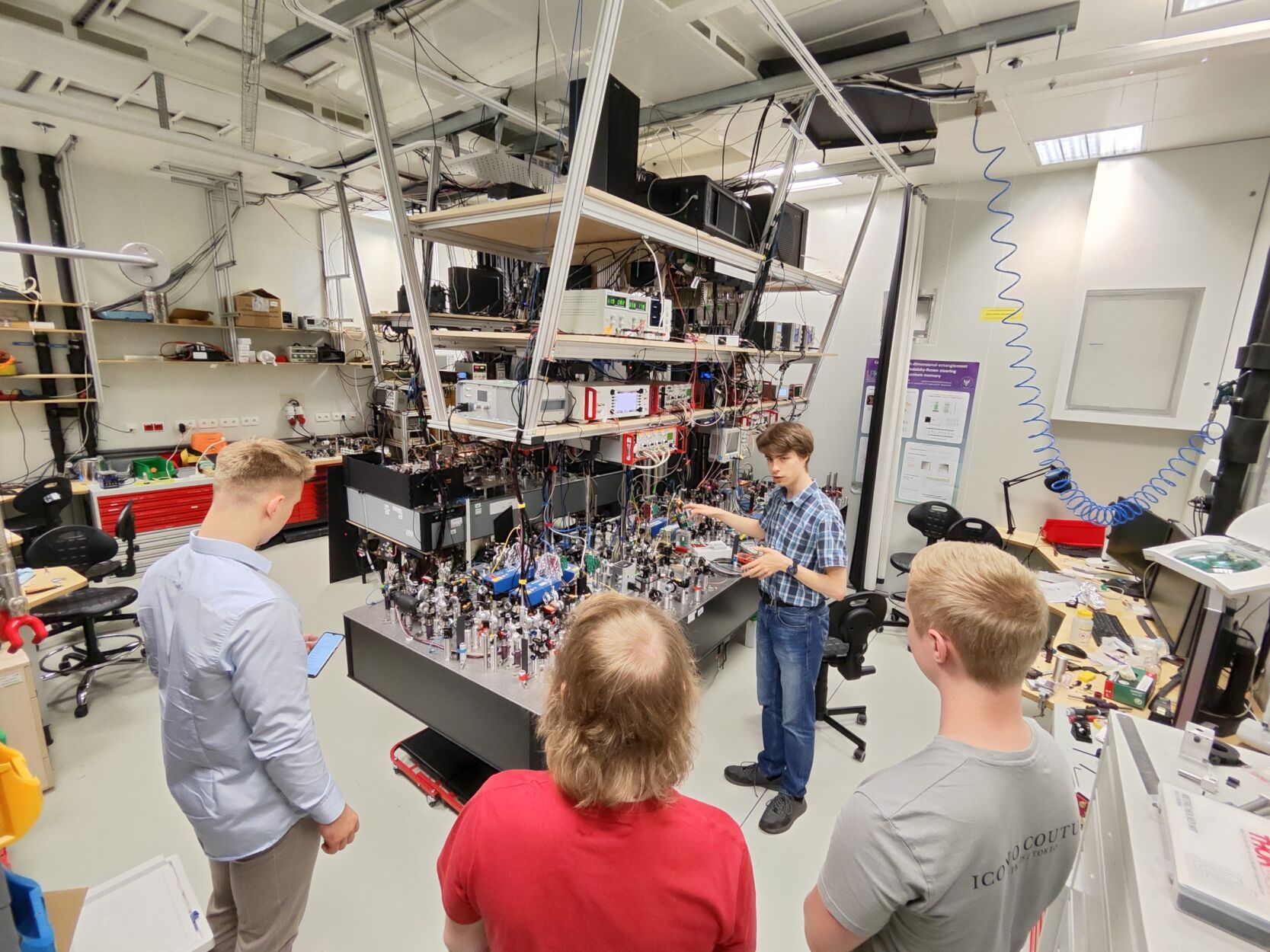
In the first phase of the project, three students from Charles University visited the University of Warsaw. The visit was organized to coincide with the OPTO23 conference in Gdańsk, which participants attended independently of the project funding. At UW, students explored three research laboratories focused on quantum photonics, quantum memory, and quantum-optical instrumentation. UW students organized a dedicated seminar where they presented their ongoing research and discussed methodologies and experimental approaches with the visiting group. Beyond the formal program, the visit included shared social activities, such as a joint dinner and an informal evening walk through Warsaw. These moments provided space for open discussion, networking, and the exchange of ideas in a relaxed setting, helping to strengthen personal and professional connections.
Visit to Prague
The second phase brought students from Heidelberg University and the University of Warsaw to Prague. On the first day, the visitors toured several research laboratories at the Troja and Karlov campuses of Charles University. A shared lunch between the site visits further encouraged informal discussion among students. In the afternoon, the guests attended a lecture by Dr. Tatiana Novikova (École Polytechnique, IP Paris), invited specifically for this occasion. The day concluded with an informal group dinner. On the following day, the visitors were given a guided tour of Prague, during which potential avenues for future collaboration were discussed. One promising outcome was the idea of establishing a SPIE or Optica student chapter at Heidelberg University, which could significantly enhance future joint activities. In the afternoon, the visiting students and additional CU participants toured the ELI Beamlines facility in Břežany, part of the Extreme Light Infrastructure and home to some of the world’s most powerful laser systems. The visit included short introductory presentations, guided observation of laboratory spaces from viewing platforms, and an interactive virtual-reality installation.
Outcome and Impact
Overall, the project was highly successful. It revitalized collaboration with colleagues at the University of Warsaw, where previous student-led ties had weakened following the graduation of former chapter officers, and it established new connections with Heidelberg University that show strong potential for future cooperation. Through a combination of academic exchange, laboratory visits, and informal networking, the project created a solid foundation for continued international engagement and student-driven initiatives.